†Tetsuo Hayakawa*1, Keisuke Kurokawa*2, Ken-Ichiro Kato*1
Cite
Hayakawa T, Kurokawa K, Kato K. Thyroid storm with elevated presepsin without infection due to methimazole administration. Lab Med Int 2024; 3(2): 28-32. doi.org: 10.51041/lmi.3.2_28
Case Report
Lab Med Int 2024; 3(2): 28-32
† Correspondence: Department of Diabetes Mellitus and Endocrinology, Tonami General Hospital, 1-61 Shintomi-Cho, Tonami, 939-1395, Japan. E-mail: thayakawaendo”@”gmail.com
Received October 3, 2023; accepted May 14, 2024
*1 Department of Diabetes Mellitus and Endocrinology, Tonami General Hospital
*2 Department of Cardiology, Tonami General Hospital
ABSTRACT
A 43-year-old woman was diagnosed with thyroid storm due to Graves’ disease. Fever and inflammatory reactions
were observed; however, the infectious focus was unclear. The patient was administered methimazole,
potassium iodide, and meropenem. The presepsin levels increased and the fever persisted, but the C-reactive
protein and procalcitonin (PCT) levels decreased. The meropenem and methimazole were discontinued, and
propylthiouracil was initiated. The patient’s presepsin levels and thyroid function decreased; however, her fever
continued. A total thyroidectomy was performed, and the patient’s fever improved while her presepsin and PCT
levels normalized. Treatment with methimazole during thyroid storm may result in the secretion of presepsin
without infection, which must be considered when diagnosing sepsis in patients with thyroid storm.
Key Words
presepsin, procalcitonin, thyroid storm, methimazole
I. Introduction
Thyroid storm is a life-threatening endocrine emergency that originates from thyroid toxicosis. The condition manifests as the decompensation of multiple organs with a high fever, disturbed consciousness, heart failure, diarrhea, and jaundice 1). Patients with thyroid storm and fever must be monitored carefully as severe thyroid storm may be complicated by pneumonia or urinary tract infections 2).
Presepsin and procalcitonin (PCT) are novel diagnostic and prognostic markers for sepsis. Presepsin is considered a promising biomarker for diagnosing sepsis and can be detected during sepsis earlier than C-reactive protein (CRP) and PCT 3).
This report presents a patient with thyroid storm who was treated with methimazole and experienced an increase in her plasma presepsin level without infection.
II. Case report
A 43-year-old woman was admitted to our hospital for thyroid toxicosis with a temperature of 39.2℃, blood pressure of 131/59 mmHg, heart rate of 145 /min, and nausea. Acute physiology and chronic health evaluation (APACHE) II score and sequential organ failure assessment (SOFA) score were 12 and two points, respectively. The thyroid gland was slightly enlarged. Ultrasonography of the thyroid gland revealed a heterogeneous internal echo with slightly increased blood flow (Figure 1). The TSH receptor antibody (TRAb) and thyroid stimulating antibody (TSAb) were elevated (5.1% and 685%, respectively). The patient was diagnosed with thyroid storm due to Graves’ disease. The clinical course of the patient is shown in Figure 2. She was administered methimazole (60 mg/day), potassium iodide (0.2 g/day), landiolol (1 μg/kg/min for a total of 68 mg/day), hydrocortisone (200 mg/day for hospital days 1-3), and acetaminophen (2.4 g/day). The patient’s inflammatory responses, such as white blood cell (WBC) count and CRP and PCT levels, were also elevated. The blood cultures were negative. Whole-body computed tomography (CT) and echocardiography were conducted; however, the infection focus remained unclear. Thyroid storm complicated by bacterial infection was suspected, and meropenem (1 g/day) was administered. Palpitation and nausea improved immediately, but the fever persisted. The patient’s CRP, PCT, and T.Bil levels decreased, but the presepsin, ALP, and γ-GTP levels increased. Renal function, AST, and ALT levels were within normal ranges. The infection focus was unclear on gallium scintigraphy and repeated whole-body CT. The blood culture results were negative. It was believed that the bacterial infection improved. The meropenem was discontinued on hospital day 12. The patient’s CRP and PCT levels continued to decrease; however, her presepsin, ALP, and γ-GTP levels increased, and the fever continued. On hospital day 20, the methimazole was discontinued and propylthiouracil was initiated due to the possibility of fever secondary to methimazole. The patient’s presepsin, ALP, and γ-GTP levels decreased. Thyroid function decreased, but her fever continued. It was believed that the fever was due to thyroid storm, and a total thyroidectomy was performed on hospital day 27. Histopathological features revealed fibrotic tissues, and the follicular epithelia exhibited local hyperplasia and papillary proliferation. Scalloping, formed by vacuoles in the colloid adjacent to the apex of the follicle cells, was increased locally. Lymphocytic infiltration with follicular formation was observed in the interstitial tissues. These findings are consistent with Graves’ disease after treatment (Figure 3). The patient’s fever resolved immediately after thyroidectomy. The presepsin and PCT levels normalized one and two months after surgery, respectively.
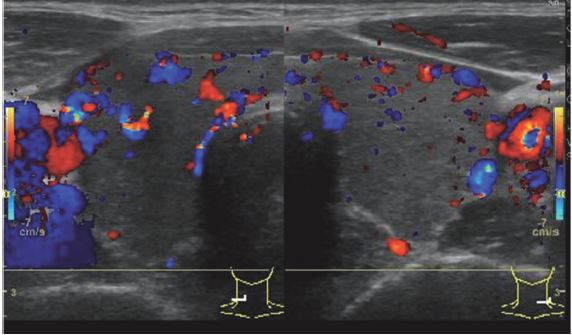
Figure 1 Ultrasonography of the thyroid gland showing heterogeneous internal echo and slightly increased of blood flow.
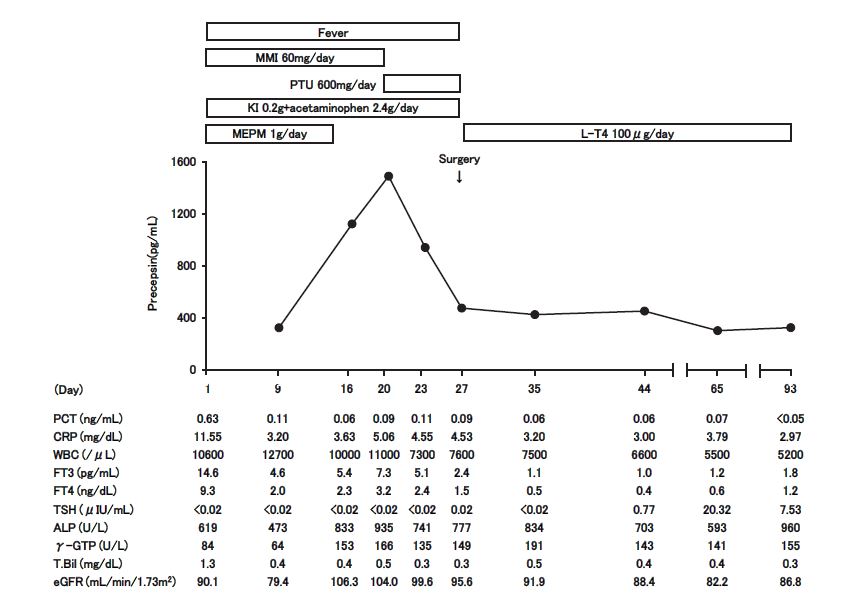
Figure 2 Clinical course. Day 1 indicates admission. KI=potassium iodide, MEPM=meropenem, MMI=methimazole,
PCT=procalcitonin, PTU=propylthiouracil.
III. Discussion
Fever is reported in 63.5-64.9% of Japanese patients with thyroid storm 1). The irregular use or discontinuation of antithyroid drugs and infections account for 44.7% and 31.4% of cases of thyroid storm, respectively 1). Upper respiratory tract infections, acute bronchitis/pneumonia, and agranulocytosis/sepsis account for 41.5%, 20.7%, and 3.7% of the infections leading to thyroid storm, respectively 4).
In this patient, thyroid storm complicated by bacterial infections was suspected upon admission due to the patient’s WBC count and CRP and PCT levels. The bacterial infection was believed to improve during the treatment as the CRP and PCT levels decreased; however, the presepsin levels increased. The patient’s meropenem was discontinued and the methimazole was changed to propylthiouracil; however, the fever continued. The fever was believed to be due to the thyroid storm, and a total thyroidectomy was performed.
Presepsin is a 13-kDa protein that is the truncated N-terminal fragment of CD14 and is highly expressed on the membrane surfaces of monocytes 5). Presepsin secretion by monocytes is triggered by bacterial phagocytosis or sterile phagocytic stimuli. Elastase in monocytes mediates CD14 cleavage to produce presepsin 6). Presepsin levels are significantly elevated in patients with sepsis and hemophagocytic syndrome 6-8). Presepsin levels may also increase with an increase in macrophage phagocytic activity. In a previous report, a patient with Graves’ disease developed agranulocytosis and hemophagocytic syndrome after the administration of methimazole 9); however, the patient’s presepsin levels were not reported. PCT is secreted from multiple tissues during bacterial infection, including the liver, kidneys, lungs, intestines, and muscles 10). In the current patient, fever was observed without splenomegaly, cytopenia, hypertriglyceridemia, or hypofibrinogenemia. As the bone marrow, ferritin levels, and soluble interleukin-2 receptor levels were not examined, hemophagocytic syndrome could not be diagnosed.
Presepsin levels were correlated with the elevation of biliary enzymes in patients without renal dysfunction or sepsis. Presepsin production in liver Kupffer cells was confirmed by immunostaining 11). These findings suggest that increased bile duct pressure results in presepsin over expression in the Kupffer cells, leading to elevated presepsin levels in both the bile and plasma 11). In this patient, ALP and γ-GTP levels increased after the administration of methimazole, and decreased when methimazole was changed to propylthiouracil. It is possible that presepsin level increased due to the increase of bile duct pressure by methimazole; however, as we did not perform immunostaining of presepsin in the liver, this could not be proven. The frequency of severe liver injury, such as hepatic coma and hepatic failure, or mild liver injury to the use of methimazole was 0.05% or 0.09%, respectively. The frequency of severe or mild liver injury to the use of propylthiouracil was 0.17% or 0.04%, respectively 12). Liver injury associated with methimazole is related to cholestasis, whereas the liver injury associated with propylthiouracil is related to hepatitis 12).
Presepsin levels have been shown to be significantly increased in patients with renal dysfunction 13,14). As presepsin is a 13-kDa protein, it is freely filtered by the glomerulus and almost completely reabsorbed and catabolized with proximal tubular cells 14). In this patient, renal function was within the normal range.
Presepsin is correlated with disease activity in patients with systemic lupus erythematosus (SLE), for which several reasons have been proposed 15). The clearance ability of apoptotic body/cellular debris and neutrophil phagocytosis are impaired in these patients and the cathepsin D activity and neutrophil extracellular cell trap production are increased. In patients with thrombocytopenia, anasarca, fever, reticulin fibrosis, and organomegaly (TAFRO) syndrome, the presepsin and alkaline phosphatase levels are increased 16). Presepsin and troponin levels are significantly elevated in patients with acute myocardial infarction (AMI)17). However, the mechanisms underlying increased presepsin levels in patients with TAFRO syndrome and AMI are not well known.
In this patient, the presepsin level decreased when methimazole was changed to propylthiouracil. Treatment with methimazole during a thyroid storm may lead to presepsin secretion via a sterile phagocytic stimulus or an increase of bile duct pressure. We did not perform immunostaining of presepsin in the liver or thyroid gland. The precise mechanism underlying the methimazole-induced increase in presepsin levels is unclear. Further studies are needed to elucidate the mechanism by which methimazole increases the presepsin level in patients with thyroid storm without infection.
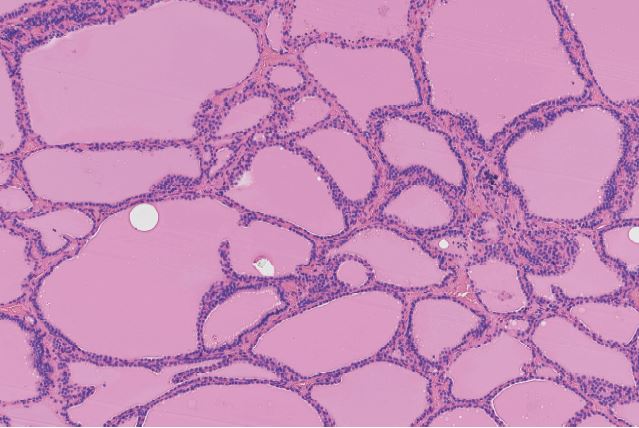
Figure 3 Histopathological features of thyroid specimen shown by hematoxylin and eosin staining ( × 100).
Conflict of Interest
The authors declare that they have no conflicts of interest.
References
- Akamizu T, Satoh T, Isozaki O, et al. Diagnostic criteria, clinical features, and incidence of thyroid storm based on nationwide surveys. Thyroid 2012; 22(7): 661-79.PubMed
- Satoh T, Isozaki O, Suzuki A, et al. 2016 Guidelines for the management of thyroid storm from The Japan Thyroid Association and Japan Endocrine Society (First edition). Endocr J 2016; 63(12): 1025-64.PubMed
- Hung SK, Lan HM, Han ST, et al. Current evidence and limitation of biomarkers for detecting sepsis and systemic infection. Biomedicines 2020; 8(11), 494: doi:10.3390/biomedicines8110494.PubMed
- The Japan Thyroid Association and the Japan Endocrine Society. 2017 guidelines for the management of thyroid storm. Tokyo: Nankodo; 2017. p.12-3 (in Japanese).
- Yaegashi Y, Shirakawa K, Sato N, et al. Evaluation of a newly identified soluble CD14 subtype as a marker for sepsis. J Infect Chemother 2005; 11(5): 234-8.PubMed
- Arai Y, Mizugishi K, Nonomura K, et al. Phagocytosis by human monocytes is required for the secretion of presepsin. J Infect Chemother 2015; 21(8): 564-9.PubMed
- Nanno S, Koh H, Katayama T, et al. Plasma levels of presepsin (soluble CD14-subtype) as a novel prognostic marker for hemophagocytic syndrome in hematological malignancies. Intern Med 2016; 55(16): 2173-84.PubMed
- Koh H, Nanno S, Katayama T, et al. Diagnostic usefulness of plasma presepsin (soluble CD14-subtype) for diagnosing hemophagocytic syndrome in hematological malignancies. Leuk lymphoma 2017; 58(10): 2489-92.PubMed
- Lew WH, Chang CJ, Lin JD, et al. Successful preoperative treatment of a Graves’ disease patient with agranulocytosis and hemophagocytosis using double filtration plasmapheresis. J Clin Apher 2011; 26(3): 159-61.PubMed
- Müller B, White JC, Nylén ES, et al. Ubiquitous expression of the calcitonin-I gene in multiple tissues in response to sepsis. J Clin Endocrinol Metab 2001; 86(1): 396-404.PubMed
- Yamaguchi T, Ohira M, Kawagoe N, et al. High presepsin concentrations in bile and its marked elevation in biliary tract diseases: A retrospective analysis. Clin Chim Acta 2021; 521: 278-84.PubMed
- Rivkees SA, Szarfman A. Dissimilar hepatotoxicity profiles of propylthiouracil and methimazole in children. J Clin Endocrinol Metab 2010; 95(7): 3260-7.PubMed
- Nagata T, Yasuda Y, Ando M, et al. Clinical impact of kidney function on presepsin levels. PLoS One 2015; 10(6): e0129159.PubMed
- Chenevier-Gobeaux C, Trabattoni E, Roelens M, et al. Presepsin (sCD14-ST) in emergency department: The need for adapted threshold values? Clin Chim Acta 2014; 427: 34-6.PubMed
- Tanimura S, Fujieda Y, Kono M, et al. Clinical significance of plasma presepsin levels in patients with systemic lupus erythematosus. Mod Rheumatol 2018; 28(5): 865-71.PubMed
- Shimizu N, Yamaguchi T, Terai K, et al. A case of TAFRO syndrome who showed remarkable elevation of presepsin level without an apparent infectious disease. JJSLM 2022; 70(1): 29-34 (in Japanese).
- Caglar FNT, Isiksacan N, Biyik I, et al. Presepsin (sCD14-ST): could it be a novel marker for the diagnosis of ST elevation myocardial infarction? Arch Med Sci Atheroscler Dis 2017; 2(1): e3-8.PubMed